· 3 min read · Amir Emad
The break-even ROAS formula that includes your fixed costs
The usual break-even ROAS formula fits in one line and is wrong for almost every real business. It forgets that you pay rent. Here is the version that doesn't, and what it does to the number.
The formula most calculators give you
Search for break-even ROAS and you will find the same formula almost everywhere:
Break-even ROAS = 1 ÷ margin
With a 50% margin you need 2x. With a 25% margin you need 4x. It is quick, and it answers a real question: the ROAS at which one order pays for its own product costs and the ad that won it.
It does not answer the question you actually care about, which is whether the month makes money. It leaves out everything your business pays whether or not an ad runs: salaries, rent, software, the retainer you pay someone to run your store. Those costs come out of the same margin, so they belong in the formula.
The version that includes fixed costs
Start from the month, not from one order. Your profit is what your sales leave after the costs that come with each order, minus the ad spend, minus your fixed costs:
Profit = Revenue × contribution margin − ad spend × (1 + fees on spend) − fixed costs
Contribution margin is the share of each sale left after product cost, shipping, payment fees and refunds. "Fees on spend" covers anything charged as a percentage of your ad budget, such as an agency fee or VAT on ads.
Set profit to zero, divide both sides by ad spend, and you get the ROAS at which the month breaks even:
Break-even ROAS = (ad spend × (1 + fees on spend) + fixed costs) ÷ (ad spend × contribution margin)
Notice that ad spend appears twice. That is the whole point. Your break-even ROAS is not one number. It depends on how much you spend.
A worked example
Take a skincare store with these numbers:
- average order value $60, with a 70% gross margin, so the product costs $18
- $6 to ship each order
- a 3% payment fee, which is $1.80 on an average order
- 4% of orders refunded, costing $1.68 of margin per order on average
- $8,000 a month of fixed costs
- no agency fee and no VAT on ads
What is left from one order is $32.52, a contribution margin of 54.2%. The short formula says break-even is 1 ÷ 0.542 = 1.85x.
This month the store spent $12,000 and got a 2.60x ROAS. By the short formula that looks comfortable, well above 1.85x. Here is the same month on the chart:
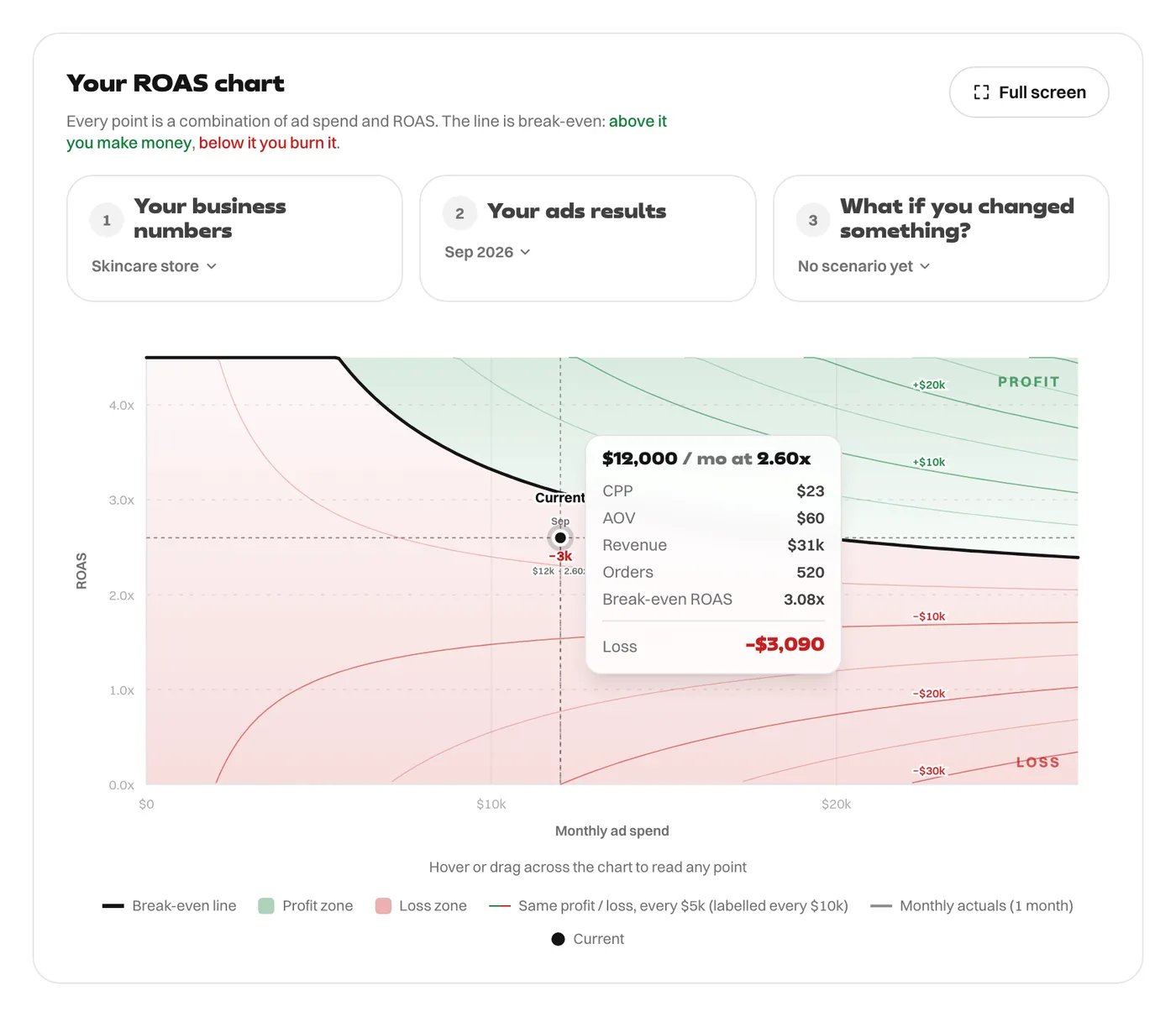
With fixed costs included, break-even at $12,000 a month is 3.08x. The campaign brought in $31,200 of revenue and the month lost $3,090. The short formula was out by more than a full point of ROAS.
Break-even falls as you spend more
Because fixed costs are the same whatever you spend, a bigger budget spreads them over more revenue. Here is the same store at different levels of spend:
| Monthly ad spend | Break-even ROAS |
|---|---|
| $5,000 | 4.80x |
| $10,000 | 3.32x |
| $12,000 | 3.08x |
| $20,000 | 2.58x |
| $40,000 | 2.21x |
The number keeps falling but never reaches 1.85x. That lower limit is the short formula's answer, and it is the least you could ever need, with an infinite budget. Everywhere else you need more. That lower limit is often called your minimum ROAS, or your floor: below it, every order loses money whatever you spend.
Two things to take from this
Quote your break-even at your actual spend. "My break-even ROAS is 1.85" is true only for a business that pays no rent. The useful sentence is "at $12,000 a month my break-even is 3.08x".
Check it again whenever the budget moves. Raising spend from $12,000 to $20,000 brings break-even down from 3.08x to 2.58x. That only helps if your ROAS holds up as you scale. Usually it drops, and then the two numbers race each other.
Work out yours
You need four things: what one order leaves after its own costs, your monthly fixed costs, any fees charged on ad spend, and your budget. Put them into the formula above, or into the free calculator on this site, which draws the whole line so you can see where every level of spend lands.
For the broader question of what ROAS to aim for, read what is a good ROAS.
Every figure in this article comes from the ROAS Chart calculator, and the screenshots show it with the same numbers. The formulas are written out on the math behind it.