· 3 min read · Amir Emad
Minimum ROAS: the floor your ads can never go below
Every store has a ROAS below which no amount of spend can ever make money. Knowing that number tells you whether a losing campaign needs more budget or a different business model.
What minimum ROAS means
There are two numbers people call "minimum ROAS", and it helps to separate them.
The first is the floor: the ROAS below which an order loses money before you have paid a single fixed cost. It depends only on your unit economics:
Floor = (1 + fees on ad spend) ÷ contribution margin
The second is your break-even ROAS at your current spend, which also has to cover rent, salaries and software. It is always higher than the floor. It falls toward the floor as spend grows, but never reaches it.
Meta's bid control that is now called a ROAS goal used to be called minimum ROAS, which adds to the confusion. That setting is a target you give the algorithm. The floor is a property of your business.
A worked example
An outdoor gear store sells at an average of $110 with a 55% gross margin. Shipping is $12, payments 3%, refunds 6%. That leaves $41.57 per order, a contribution margin of 37.8%. No agency fee, no VAT on ads.
Its floor is 1 ÷ 0.3779 = 2.65x. At any ROAS below that, each extra order loses money, and spending more makes the loss bigger.
It has $20,000 a month of fixed costs. Watch how its real break-even approaches the floor as spend grows:
| Monthly ad spend | Break-even ROAS |
|---|---|
| $10,000 | 7.94x |
| $25,000 | 4.76x |
| $50,000 | 3.70x |
| $100,000 | 3.18x |
| $200,000 | 2.91x |
| $400,000 | 2.78x |
At $10,000 a month it needs almost 8x. At $400,000 it needs 2.78x, close to the 2.65x floor but still above it.
On the chart
This month the store spent $50,000 at 2.90x:
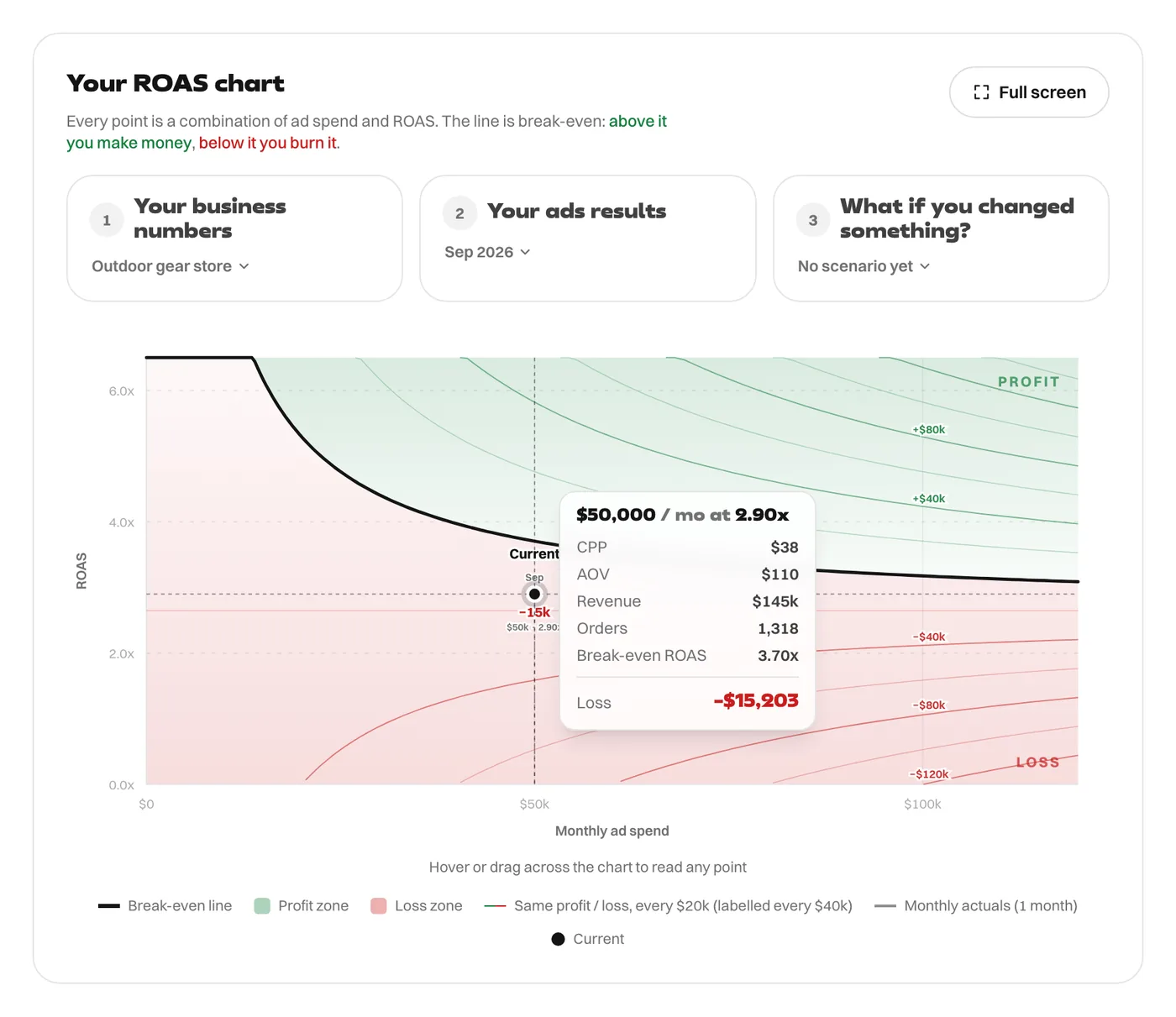
The black line is break-even at each level of spend. It drops steeply at first, as fixed costs get spread thinner, then flattens as it approaches the floor. This month's point sits below it: break-even at $50,000 is 3.70x, and the month loses $15,203.
The ROAS here, 2.90x, is above the floor. That matters: it means the loss is a fixed-cost problem, and more volume could close it if ROAS held. The table shows that at $200,000 a month, break-even is 2.91x. A store running below its floor has no such option.
How to use the floor
- Below the floor: stop scaling. More spend multiplies the loss. The fix is in the product, price, shipping or returns, not in the ads.
- Above the floor, below break-even: you have a fixed-cost problem. Growing spend, if ROAS holds, can carry you into profit. So can trimming overheads.
- Above break-even: you are profitable at this spend. The question becomes how far you can scale before ROAS falls below the line.
If you set a ROAS goal in Meta, never set it below your floor. Set it at or above your break-even for the spend you intend to run.
For the full formula behind the line, see the break-even ROAS formula with fixed costs. To see how a fee charged on ad spend raises the floor itself, see VAT on Meta ads in the UAE.
Every figure in this article comes from the ROAS Chart calculator, and the screenshots show it with the same numbers. The formulas are written out on the math behind it.