· 3 min read · ROAS Chart
Ecommerce return rate: what refunds do to your break-even ROAS
Returns are usually treated as a customer service problem. For a store that advertises, they are also an advertising problem: each one takes margin from an order you paid to win, and your ad platform keeps counting it as a sale.
What a refund really costs you
When an order is refunded, you give back the revenue. If the product comes back in sellable condition, you get the product cost back as stock. What you lose is the margin on the sale, plus the shipping you already paid, plus return shipping if you cover it.
That loss happens on a share of every order your ads win. So your refund rate is a cost per order, just like shipping, and it belongs in your break-even ROAS.
ROAS Chart treats it this way: you enter the ROAS your ads report, which counts refunded orders as sales, and the refund rate takes off the margin you later lose. If you also pay return postage or often cannot resell returned items, add those costs to shipping.
A worked example
A womenswear store sells at an average of $90 with a 60% gross margin. Shipping costs $10 and payments 3%. Like many fashion stores, it sees a lot of returns: 20% of orders are refunded.
Those refunds cost $10.80 of margin per order on average, more than the shipping. Each order leaves $30.50, a contribution margin of 33.9%, and the floor is 2.95x. Fixed costs are $5,000 a month.
It spends $20,000 a month at 3.40x. Break-even is 3.69x, and the month loses $1,956.
The store adds a sizing guide, better photos and fit notes from reviews, and returns fall to 12%:
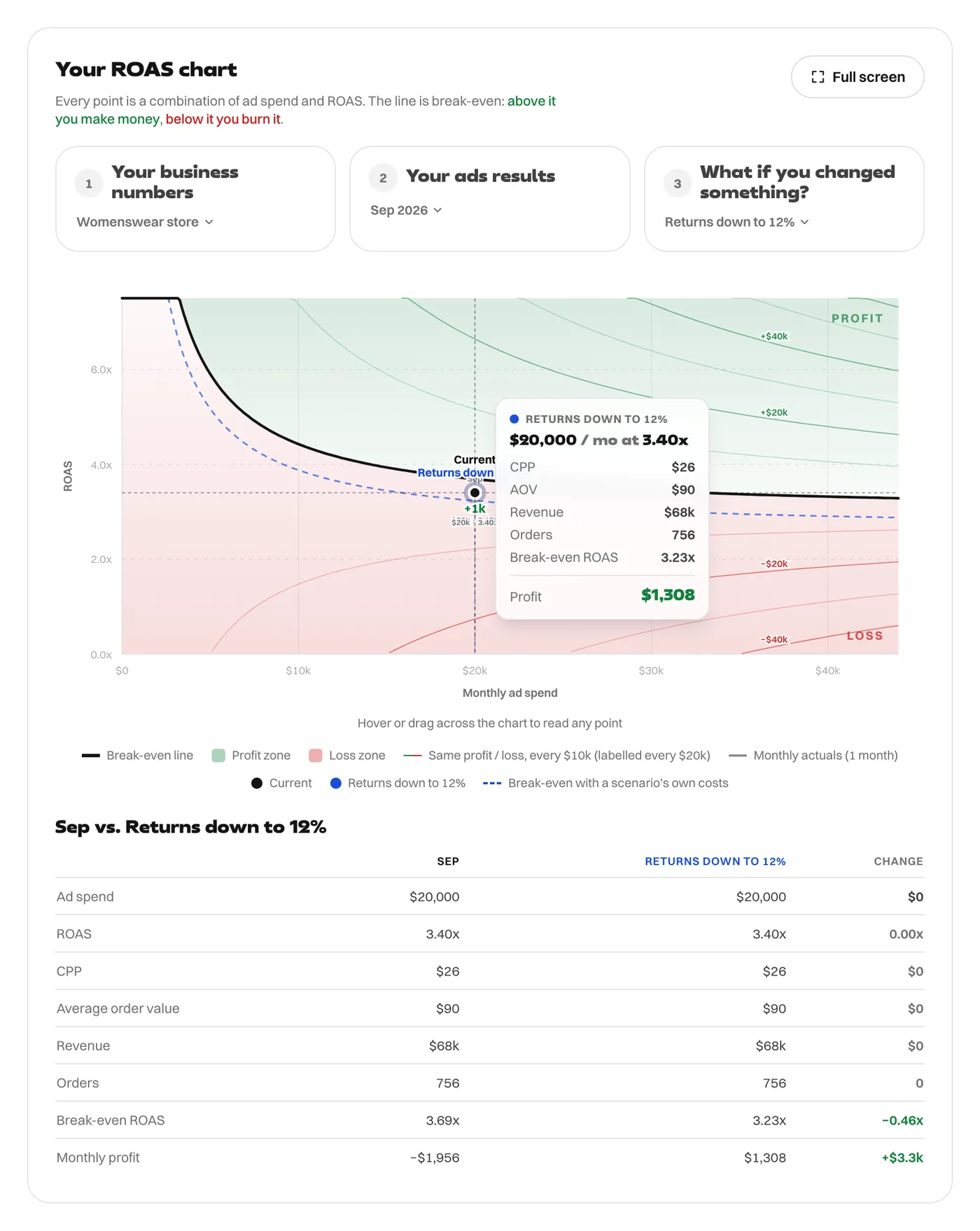
Each order now leaves $34.82, a contribution margin of 38.7%. Break-even at $20,000 falls from 3.69x to 3.23x, the floor from 2.95x to 2.58x, and the month goes from a $1,956 loss to a $1,308 profit. Nothing changed in the ad account.
Why returns hurt more than they look
A 20% return rate sounds like it costs 20% of revenue. It costs less than that, because you get the stock back. But it lands entirely on your margin, and your margin is what pays for the ads. Here, returns took 12 points of contribution margin, more than a quarter of what the store would otherwise keep.
There is also a hidden effect on your reported ROAS. Ad platforms count the purchase when it is placed and do not subtract it when it is refunded. So the higher your return rate, the more your platform ROAS overstates the sales you keep. Accounting for refunds in your break-even corrects for that.
Ways to reduce refunds
- Size and fit information: size charts in real measurements, fit notes, and model sizes on every photo.
- Accurate photos and descriptions: colours, materials, dimensions. Surprises get returned.
- Look at return reasons by product. One or two products often cause most of the returns.
- Stop advertising products with very high return rates until they are fixed. Their true ROAS is much lower than it looks.
- Review the returns policy: free returns may lift conversion, but price that cost into your numbers.
For the other levers outside the ad account, see how to make your ROAS profitable without touching the ads. For the difference between gross and contribution margin, see contribution margin vs gross margin.
Every figure in this article comes from the ROAS Chart calculator, and the screenshots show it with the same numbers. The formulas are written out on the math behind it.