· 3 min read · ROAS Chart
What free shipping does to your break-even ROAS
Free shipping sells. It also costs you the same amount on a small order as on a large one, which makes it one of the biggest influences on the ROAS you need. Here is how to price it in.
Free shipping is a cost on every order
Free shipping lifts conversion rates, and customers have come to expect it. But the shipping is not free. You pay it, on every order, and it comes out of the margin that pays for your ads.
Because it is charged per order rather than as a percentage, it hurts most on small orders. $9 on a $55 order is 16% of the sale. On a $100 order it would be 9%.
A worked example
A beauty tools store offers free shipping on everything. Its average order is $55, with a 65% gross margin. It pays $9 to ship each order, 3% in payment fees, and refunds 4% of orders. Each order leaves $23.67, a contribution margin of 43.0%. Fixed costs are $5,000 a month.
It spends $10,000 a month at 3.30x. Break-even is 3.49x, and the month loses $798.
It changes the offer to free shipping over $75. Customers start adding a second item to qualify, and the average order rises to $68.
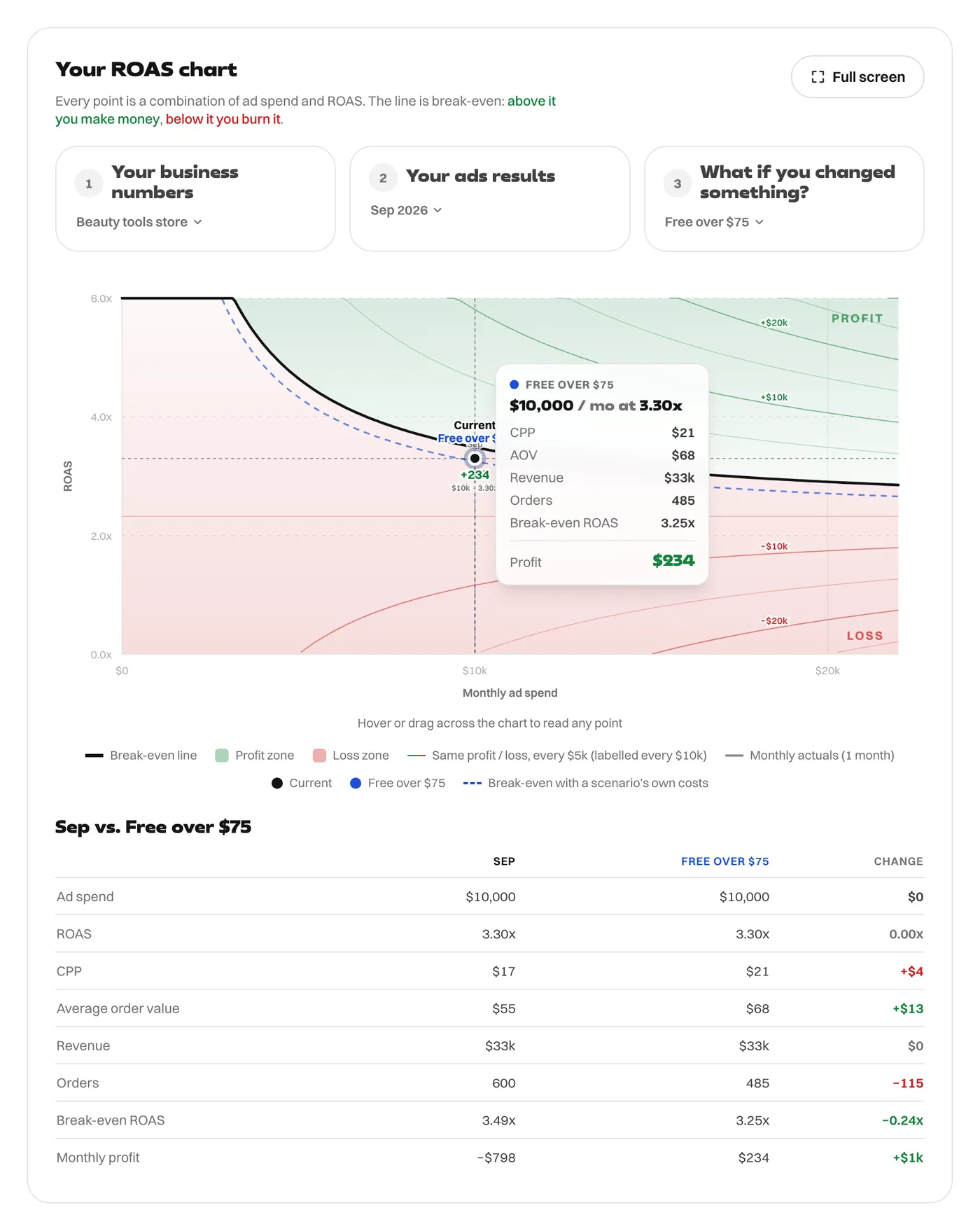
Each order now leaves $31.39, a contribution margin of 46.2%. Break-even falls from 3.49x to 3.25x, and the month goes from a $798 loss to a small $234 profit.
This is a deliberately cautious version. It still charges the store $9 of shipping on every order, as if everyone qualified for free delivery. In reality, orders under $75 now pay their own shipping, which would make the result better still. It also keeps ROAS unchanged, which means fewer, bigger orders for the same revenue.
Your options
- Free shipping on everything. Best for conversion. Most expensive. Works when orders are large relative to shipping cost.
- Free over a threshold. Set it a little above your current average order. It nudges customers to add items and protects margin on small orders.
- Flat-rate shipping. Customers pay part of the cost. Some will leave, and your margin per order improves.
- Build shipping into the price. Show free shipping but raise product prices to cover it. Test whether your conversion rate holds.
Whichever you choose, the test is the same: put the real shipping cost per order into your break-even, and check what ROAS you need at your budget. Then compare the ROAS you actually get under each offer.
For how order value moves break-even more generally, see what raising average order value does to your break-even ROAS. For shipping alongside other per-order costs, see contribution margin vs gross margin.
Every figure in this article comes from the ROAS Chart calculator, and the screenshots show it with the same numbers. The formulas are written out on the math behind it.