· 4 min read · ROAS Chart
Is dropshipping profitable? Work it out before you launch
The honest answer is that most people who try it lose money, and they lose it for a reason that has nothing to do with creative, hooks or winning products. They never worked out what ROAS they needed before they turned the ads on.
It is a business, not passive income
Dropshipping removes the stock, not the work and not the maths. You are buying traffic and reselling a product at a markup, which is retail with someone else holding the boxes. Retail with thin margins is unforgiving, and yours are thinner than a normal shop’s because your supplier already took their cut.
What it is not is unknowable. The part that decides whether a product can work is arithmetic, and you can do it before you spend anything.
A product that can work
A $40 product that costs you $15 landed. Payment fees 3%, refunds 5%, and $500 a month for the store, apps and domain. That leaves $22.55 of every order, which is 56.4% of the sale.
So the floor, the lowest ROAS that could ever break even, is 1.77x. At $8,000 a month of ads, once the $500 is spread over the month, the real break-even is 1.89x.
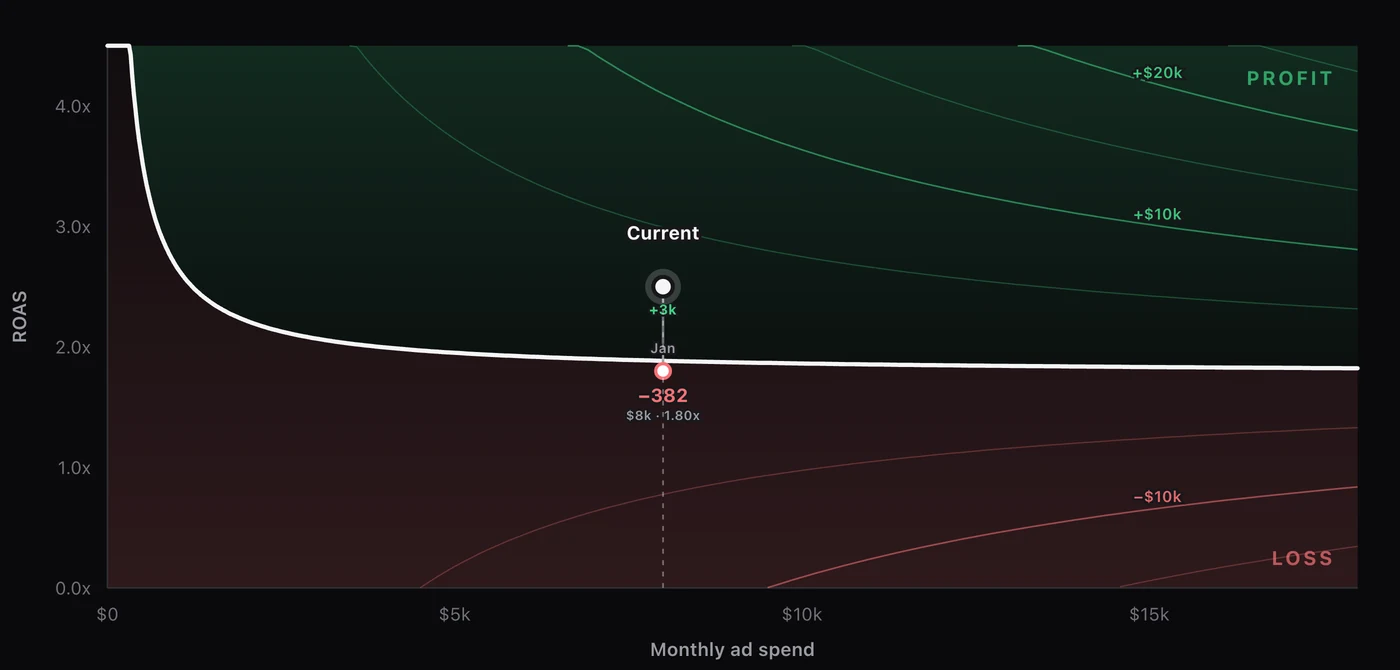
At 1.80x that month loses $382. At 2.50x it makes $2,775. The entire business is that 0.7x, and it is decided by whether your ads can buy a customer for less than $22.55 of contribution allows.
The same product that cannot
Now buy the same $40 product for $25 instead of $15, which is what happens when you pick a product first and negotiate later. Only $13.05 survives each order, 32.6% of the sale, and the floor moves to 3.06x.
Meta will rarely hand you 3.06x on cold traffic for a generic product. At that point no creative, no hook and no amount of testing rescues it, because the number was unreachable before the campaign started. That is the same trap described in the floor your ads can never go below.
Ten dollars of product cost is the difference between a business and an expensive hobby, and it never appears in the ad account.
What to check before you launch
- Work out your contribution per order. Price, minus product cost, minus shipping you pay, minus payment fees, minus the margin you lose to refunds. Use a real refund rate, not zero.
- Divide 1 by it as a share of the price. That is your floor. If it is above roughly 2.5x, ask honestly whether you can buy traffic that cheaply in your category.
- Add your monthly costs at the budget you plan to run. That is the number a campaign has to beat in month one.
- Then decide whether to launch. Not after three weeks and $2,000.
The margin you are working with is the whole game, and the margin most people use is the wrong one: gross margin flatters every product by ignoring shipping, fees and returns.
So does it work?
It works when you pick products whose numbers can clear a ROAS you can realistically buy, and when you know that number before you launch rather than after. It does not work as passive income, and it does not work if the product is chosen first and the arithmetic checked afterwards.
That is a narrower answer than the videos give you, and it is the one that survives contact with a bank statement.
Every figure in this article comes from the ROAS Chart calculator, and the screenshots show it with the same numbers. The formulas are written out on the math behind it.