· 3 min read · ROAS Chart
ROAS vs CPA vs CAC: what each one measures
ROAS, CPA and CAC all describe what it costs you to make a sale, and teams argue about which one to use. Two of them are the same number in disguise. The third answers a different question.
Three names for the cost of a sale
These three get mixed up constantly, partly because they describe the same thing from different angles.
- ROAS: revenue divided by ad spend. How much you sold per unit of advertising.
- CPA, cost per acquisition, or cost per purchase: ad spend divided by the number of purchases. How much each order cost you in ads.
- CAC, customer acquisition cost: all your marketing costs divided by the number of new customers. How much it cost to win each new customer.
ROAS and CPA are the same number, upside down
For the same set of orders, CPA and ROAS are tied together by the average order value:
ROAS = average order value ÷ CPA CPA = average order value ÷ ROAS
A home decor store with a $65 average order and a 2.90x ROAS pays $22.41 per purchase. Improve one and you improve the other. The choice between them is about what your team finds easier to reason with: ROAS when order values vary a lot, CPA when they are all similar.
Either way, you need a target. For this store, each order leaves $30.74 after its own costs, and it has $9,000 of fixed costs a month. At $15,000 of spend:
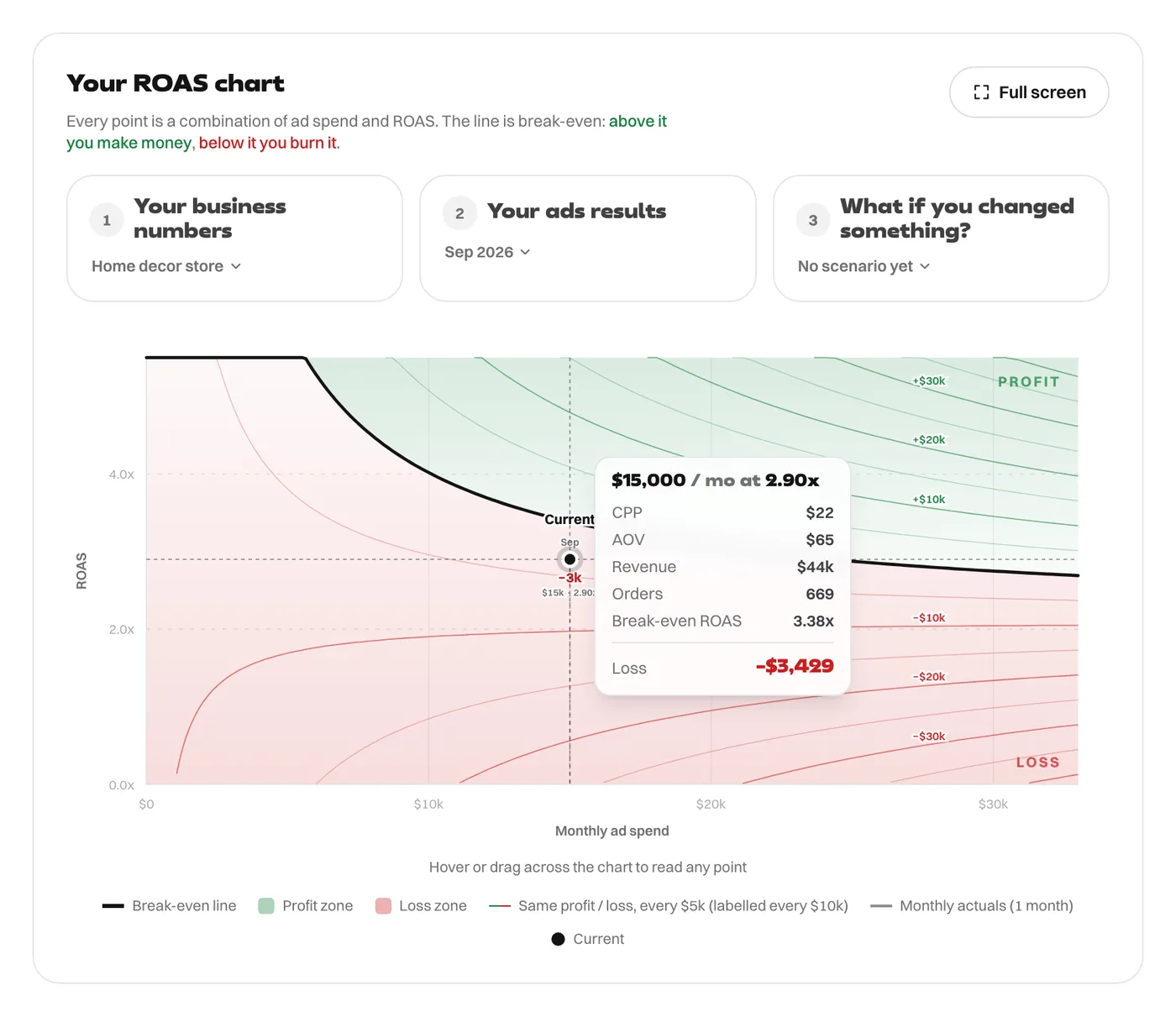
Break-even ROAS is 3.38x, which is a break-even CPA of $65 ÷ 3.38x = $19.21. The store is paying $22.41, over the limit, and the month loses $3,429. Same verdict whichever number you look at. See break-even cost per purchase for the full method.
CAC is different, and it is usually higher
CPA counts every purchase the ads are credited with, including repeat customers who would have come back anyway. CAC counts only new customers, and usually all marketing costs, not just ads.
Suppose 30% of this store's 669 ad-attributed purchases came from returning customers. Its $15,000 of ad spend won 468 new customers, a CAC of $32.02, against a CPA of $22.41. Add the cost of content, influencers or an agency retainer and CAC rises further.
CAC matters for a different decision: whether a new customer is worth what it costs to win over their whole relationship with you. That needs lifetime value. See MER vs ROAS for why store-level numbers beat platform numbers here too.
Which one to optimise for
- Day to day, in the ad account: ROAS or CPA, compared with your break-even at your current spend. They are the same decision.
- Month to month, for the business: MER and profit, from your store's own revenue.
- For growth decisions: CAC compared with what a new customer is worth over time.
Never judge any of them without a target. A $22.41 CPA sounds cheap until you know the limit is $19.21.
Every figure in this article comes from the ROAS Chart calculator, and the screenshots show it with the same numbers. The formulas are written out on the math behind it.