· 3 min read · Amir Emad
ROAS vs ROI: why a 4x ROAS can still lose money
ROAS and ROI both start with "return", and people swap them all the time. They measure different things, and the gap between them is where businesses lose money without noticing.
The difference in one line
ROAS is revenue divided by ad spend. It tells you how much you sold for each unit of advertising. ROI is profit divided by what you spent. It tells you how much you made.
ROAS = revenue ÷ ad spend ROI = profit ÷ ad spend
People define ROI in slightly different ways. Some divide by all marketing costs, some by all costs. The version above, profit per unit of ad spend, is the one that lines up with ROAS, so it is the one used here. Whatever your definition, the key point is the same: ROAS counts sales, ROI counts what is left after paying for them.
Why a high ROAS can hide a negative ROI
Between revenue and profit sit the product cost, shipping, payment fees, refunds, and the fixed costs of running the business. ROAS sees none of them. That is how a store can report a ROAS that sounds excellent while losing money.
Take a furniture accessories store. Its average order is $120, with a 45% gross margin. Shipping costs $10 because the items are bulky, payments take 3%, and 6% of orders are refunded. One order leaves $37.16, which is 31.0% of the sale. Fixed costs are $15,000 a month.
This month it spent $25,000 and got a 4.00x ROAS, which is $100,000 of revenue.
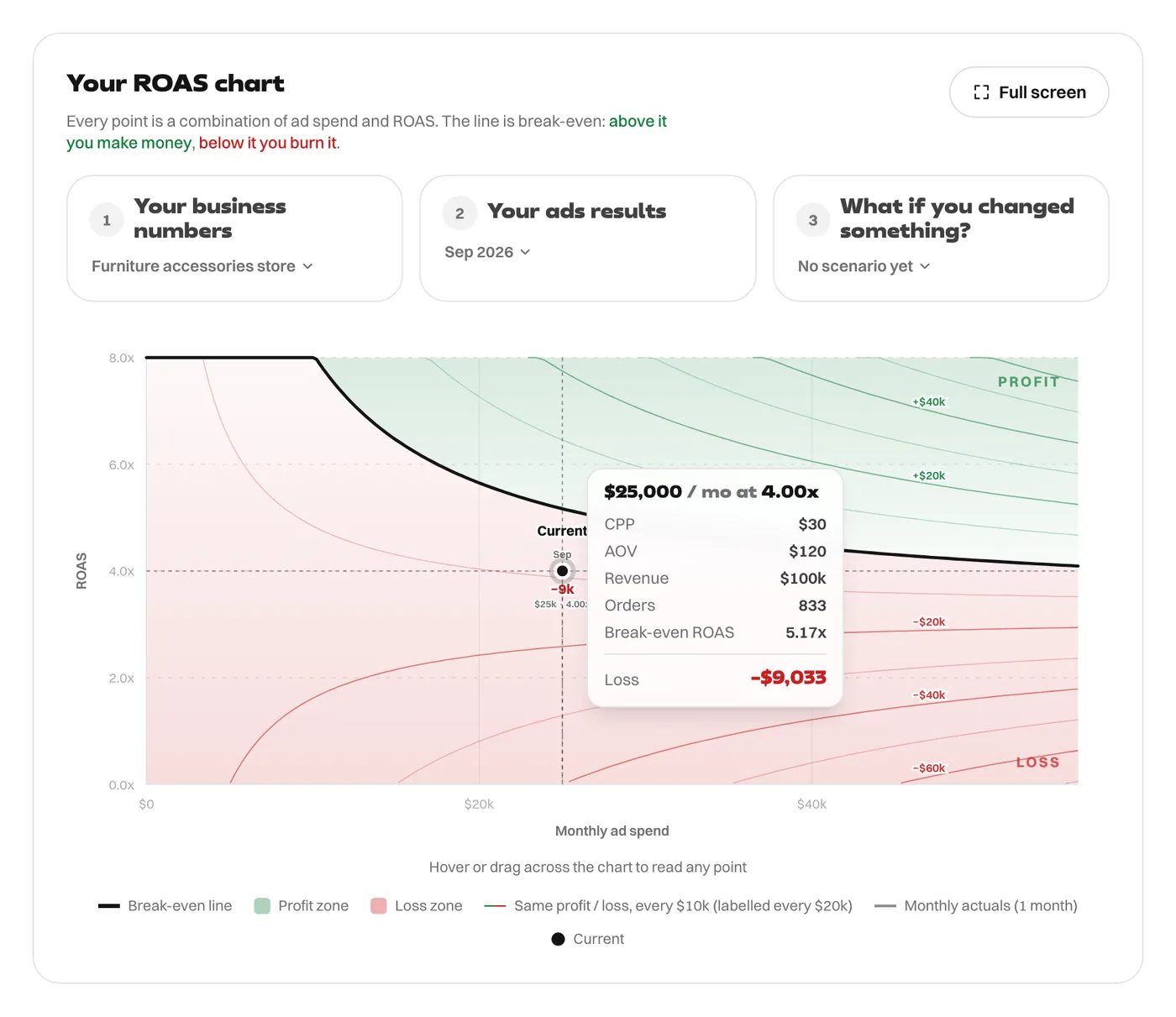
Break-even for this store at that spend is 5.17x. The month loses $9,033. Its ROI is $9,033 ÷ $25,000 = -36.1%.
So a 4x ROAS here is a -36.1% ROI. Every dollar of advertising came back as four dollars of sales, and the business lost 36 cents of it.
What the same store needs for a positive ROI
At 5.50x on the same $25,000, revenue would be $137,500, and the month would make $2,579: an ROI of 10.3%. ROI turns positive only once ROAS clears break-even.
This gives the cleanest way to connect the two measures:
- ROAS below break-even means negative ROI
- ROAS at break-even means an ROI of zero
- ROAS above break-even means positive ROI, and the gap between the two decides how much
Which one should you use?
Both, for different jobs.
ROAS is the platform's language. Meta and Google report it, bid strategies target it, and it lets you compare campaigns quickly. It is a fine day-to-day number, as long as you know what ROAS your business needs.
ROI, or plain profit, is the business's language. It is the only one that tells you whether to keep spending. Check it monthly, with your real costs.
The bridge between them is your break-even ROAS. Know it at your current spend and every ROAS report becomes an ROI report: above the line you are making money, below it you are not. Here is how to calculate it, fixed costs included.
Wondering whether your own ROAS is enough? Read is a 3x ROAS good.
Every figure in this article comes from the ROAS Chart calculator, and the screenshots show it with the same numbers. The formulas are written out on the math behind it.