· 3 min read · Amir Emad
Why ROAS drops when you scale, and how to know when to stop
Raise the budget and ROAS drops. Every media buyer has seen it. The mistake is to read that drop as failure, or to ignore it. Here is how to tell whether a lower ROAS at a higher budget is making you more money or less.
Why ROAS falls as you scale
Almost every campaign loses some ROAS as its budget grows. The reasons are well understood:
- The best buyers are found first. At a small budget, the platform spends on the people most likely to buy. More budget means reaching people with weaker intent.
- Frequency rises. The same people see your ads more often, and each extra impression is less likely to convert.
- Auction costs rise. Winning more impressions often means paying more for each one.
- Best-sellers carry the average. A few products usually drive early results. Scaling pushes spend into weaker products and audiences.
None of this means scaling is a mistake. A lower ROAS can still mean more profit, because your break-even ROAS falls as spend grows too. The question is which falls faster.
A worked example
An activewear store sells at an average of $85 with a 62% gross margin. After $7 shipping, 3% payment fees and 5% refunds, each order leaves $40.52, a contribution margin of 47.7%. Its floor is 2.10x. Fixed costs are $7,000 a month.
Today it spends $15,000 a month at 3.40x and makes $2,309. Its media buyer tests doubling the budget, and ROAS falls to 2.90x.
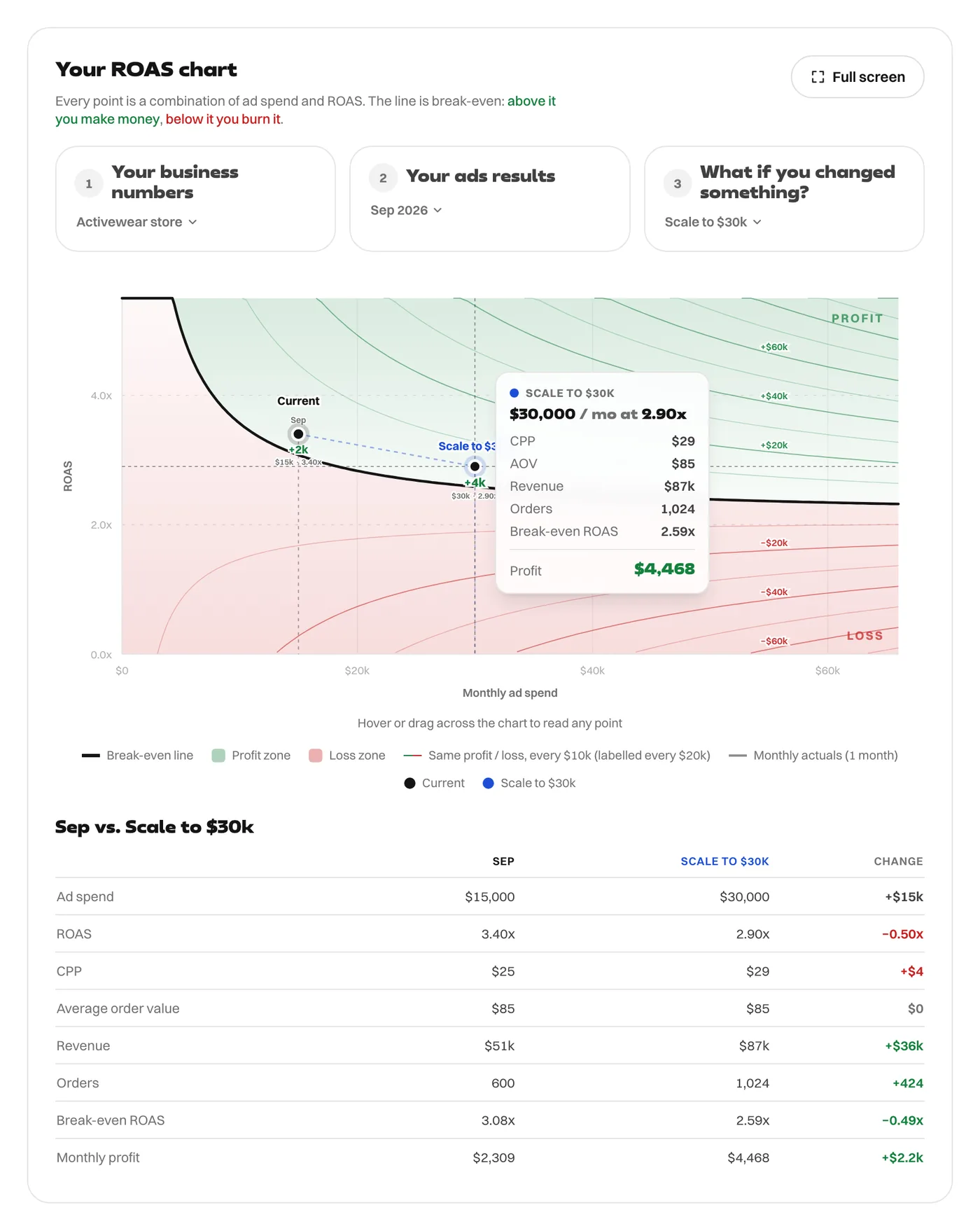
ROAS fell by half a point, but break-even fell further, from 3.08x to 2.59x. Profit went up, from $2,309 to $4,468.
Encouraged, the store doubles again, to $60,000 a month, and ROAS falls to 2.40x. Break-even there is 2.34x, so the month is still profitable, but profit drops to $1,637. Revenue is up a lot, and the store is making less money than at $30,000.
The number that tells you when to stop: marginal ROAS
The blended ROAS of the month hides what the extra spend did. To see that, look only at the increase:
Marginal ROAS = extra revenue ÷ extra ad spend
Going from $15,000 to $30,000 added $36,000 of revenue for $15,000 of extra spend: a marginal ROAS of 2.40x. Going from $30,000 to $60,000 added $57,000 for $30,000: a marginal ROAS of 1.90x.
Compare those with the floor, 2.10x. Your fixed costs are already paid by the spend you had, so each extra dollar only has to beat the floor:
- The first step returned 2.40x, above the floor, so the extra spend made money.
- The second returned 1.90x, below the floor, so every extra dollar in that step lost money.
That is the rule: keep scaling while your marginal ROAS is above your floor. Once it drops below, you are buying revenue at a loss, even if the month as a whole still looks profitable.
How to scale with this in mind
- Increase budget in steps, and give each step enough time to settle.
- After each step, work out marginal ROAS from the change in revenue and spend.
- Compare it with your floor (here is how to find yours). Above: carry on. Below: step back to the previous budget.
- Recheck when anything changes: new creative, new offer, new season.
For a store where the same ROAS turns from loss to profit with more spend, see is a 2x ROAS good.
In the calculator, add a scenario at your planned budget and expected ROAS. The chart shows the new point against the same line, and a table compares its profit with today's month.
Every figure in this article comes from the ROAS Chart calculator, and the screenshots show it with the same numbers. The formulas are written out on the math behind it.