· 3 min read · ROAS Chart
Break-even ROAS for dropshipping
Dropshipping stores live on thin margins, which means they need high ROAS to break even. The standard advice when the numbers don't work is to scale. For many stores that advice makes things worse.
Why dropshipping needs a high ROAS
Dropshipping trades margin for convenience. Your supplier holds the stock and ships the order, and you pay for both in the product price. So your gross margin is usually lower than a brand holding its own stock, and your break-even ROAS is higher.
Refunds and chargebacks also tend to run higher, because delivery times are longer and you do not control product quality. Every one of those costs comes out of an already thin margin.
A worked example
A dropshipping store sells at an average of $40. After paying the supplier for the product and its shipping, it keeps 45% of the price. Payment fees are 3.5%, and 8% of orders are refunded. Each order leaves $15.16, a contribution margin of 37.9%. That puts the floor, the lowest ROAS that could ever break even, at 2.64x.
Its fixed costs are small: $2,000 a month for apps, the store platform and a virtual assistant. It spends $6,000 a month on ads at 2.50x.
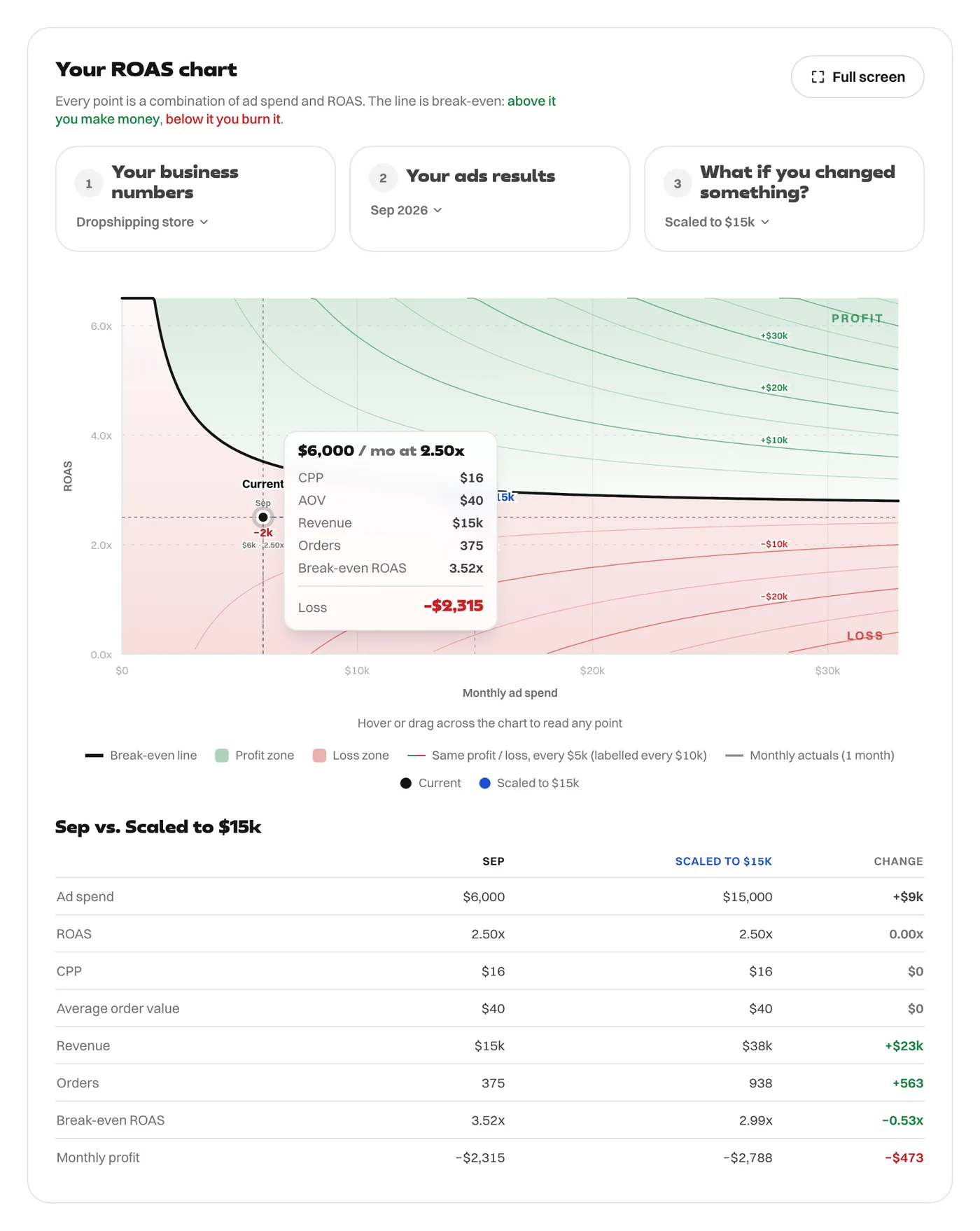
Break-even at $6,000 is 3.52x, and the month loses $2,315.
The trap: scaling below the floor
The usual advice for a losing dropshipping store is to scale: more spend spreads the fixed costs. The chart shows why that fails here. Scaling to $15,000 at the same 2.50x does lower break-even, to 2.99x, but the loss grows from $2,315 to $2,788. Even at $100,000 a month, break-even would still be 2.69x.
The reason is that 2.50x is below the 2.64x floor. At this ROAS, each order loses money before a single fixed cost: every dollar of ads brings back $0.95 of contribution. Scaling just buys more of those orders. The fixed costs were never the problem.
What actually helps
- Price. Many dropshipping products are underpriced relative to their perceived value. A higher price with the same supplier cost lifts margin directly.
- Bundles and upsells to raise the average order.
- A cheaper or faster supplier. Faster delivery also tends to cut refunds and chargebacks.
- Fewer refunds. Accurate product pages and realistic delivery times.
- Better ads, if your ROAS is above the floor. Below it, fix the unit economics first.
Check your numbers before you scale
- Work out what one order leaves after the supplier, payment fees and refunds.
- Divide 1 by that as a share of the price. That is your floor.
- If your ROAS is below the floor, do not scale. Fix price, product or supplier first.
- If it is above, scale in steps and check the ROAS at each new budget.
If you have not launched yet, work out whether the product can clear its line at all before you spend anything. For the floor in more detail, see minimum ROAS. For scaling above it, see why ROAS drops when you scale.
Every figure in this article comes from the ROAS Chart calculator, and the screenshots show it with the same numbers. The formulas are written out on the math behind it.